

Have you ever felt your content may not be good enough to rank well in search engines? Do you repeatedly rewrite your content, stuffing keywords even though it sounds robotic? If this is you, don’t worry, you aren’t alone. This is one of the common blogging mistakes. Writers check for low-quality content because:
- It is the cause of failing blog sites.
- Due to Google algorithm updates, low-quality content is removed from search.
- Readers are looking for results that actually work.
A Brief Overview of
What Google is Doing to
Check For Low-Quality Content
For years, Google has been targeting such posts, but the March 2024 core update marked the official beginning of the crackdown.
Moreover, Google presented some other changes in April, targeting low-quality and unoriginal content.

Furthermore, Google hinted that your entire site is at risk if a significant portion of your website has poor content.

If the search engine sends more traffic to high-quality websites, one may wonder what will happen to sites with low-quality content.
- Will Google target the entire website?
- Will Google demote low-quality pages first?
- How will it impact traffic and performance?
What Does Google Consider Low-Quality Content?
There are many reasons Google may consider content as low-quality. However, here are five high-risk indicators.
1.) Misleading Headlines
Misleading headlines refer to a title that doesn’t match the content. Google considers misleading headlines as a poor user experience signal.
2.) Fluffy Content
Fluffy content is wordy text. It sounds authentic or expert, but doesn’t provide actionable insights.
3.) Poor Grammar and Readability
Poor grammar or difficult-to-read writing results in the content being marked as low-quality.
4.) Unhelpful Content
Content that fails to answer the user’s question or solve their problem.
5.) Unoriginal Content
Content that has more or less the same information as similar posts and doesn’t contain anything new.
Now that you know what Google is doing, you can take steps to improve content quality before Google can take any action against you.
5 Rules on How to Check for Low-Quality Content
Based on the high-risk indicators listed above, here are five rules to follow and check for low-quality content.
Rule #1: Check That the Headline Matches the Content
The headline is the first thing the reader will see and it sets their expectations for the rest of the content. If what follows doesn’t match, they will feel tricked and leave. It will hurt both trust and ranking.
Here is an example.
Assume you come across a blog title, Proven Instagram Growth Strategies for 2025.
Put yourself in the reader’s shoes.
You would be expecting:
- Personal growth strategies shared by the writer.
- Step-by-step tactics on how they implemented it.
- An explanation of recent Instagram algorithm updates and how to work according to them.
- Real-life examples and real growth results.
If it is not what you expected, what would you do?
- You would leave the site within a few seconds.
- You may not trust the site’s content in the future because they don’t deliver what it promised.
Now you see the problem. If your post headline doesn’t match your content, the first rule is to fix it.
How to Improve the Blog Post Headline?
If your headline does not promise what you deliver, it is time for a rewrite.
Read the headline and see what it promises to deliver. Break the headline down. Consider each word or phrase as a keyword.
For example, the headline is Proven Instagram Growth Strategies for 2025.
Let’s break it down. Here is what the headline promises:
– Proven — It states that the strategies shared will work and give results.
– Instagram — The content is related to Instagram only.
– Growth Strategies — You are sharing more than one growth strategy. The strategies are for beginners and new Instagram account holders.
–2025 — You will have access to this year’s latest Instagram growth tactics.
Read your content and see if it aligns with the title. If it doesn’t — rewrite your content or change the title.
Rule #2: Check For and Remove the Fluff in Writing
Fluff derails the content. It doesn’t share any meaningful points about the topic. It is just wordy text written in an attempt to make the post sound authentic. If your words wander, so will your audience.
How to Remove Fluff From Writing?
Here is an example of fluff from rule #1 content I wrote before.
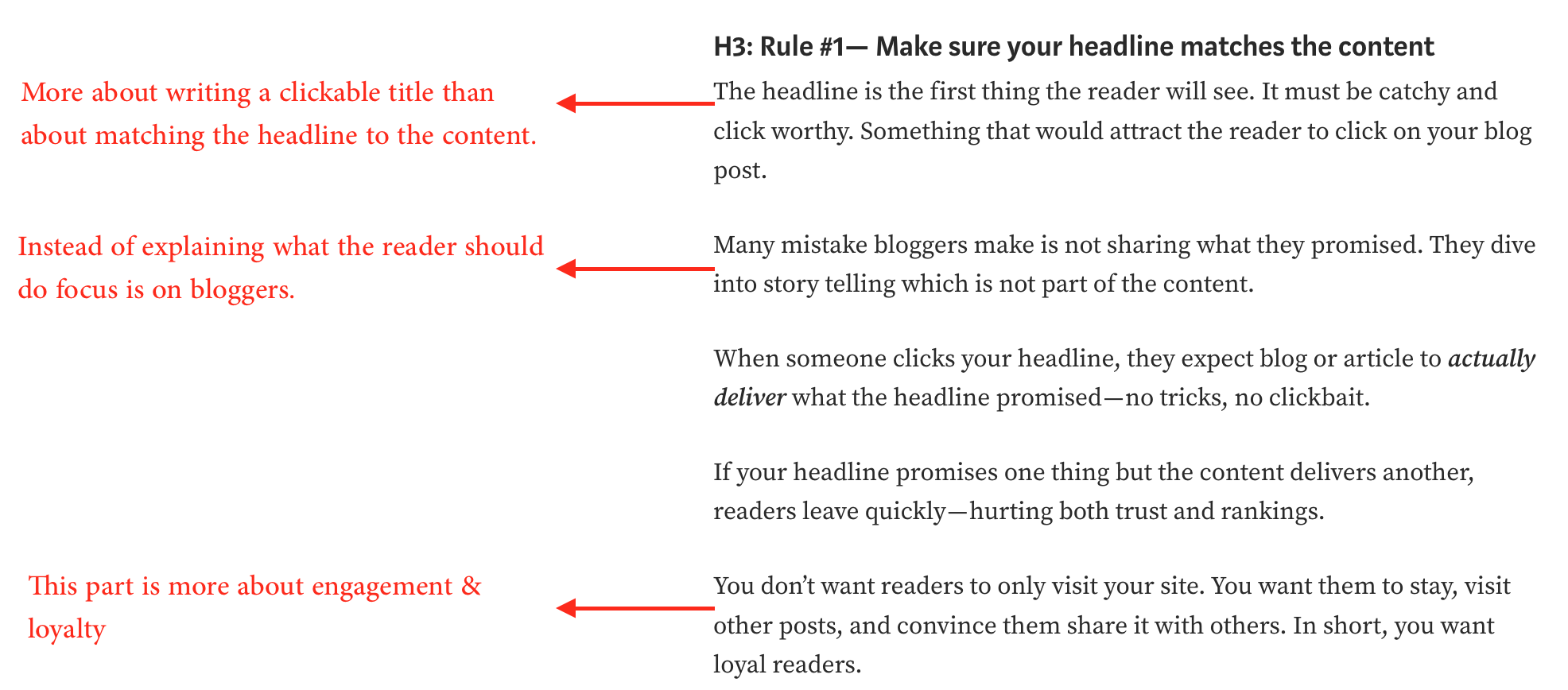
And now here is the revised version
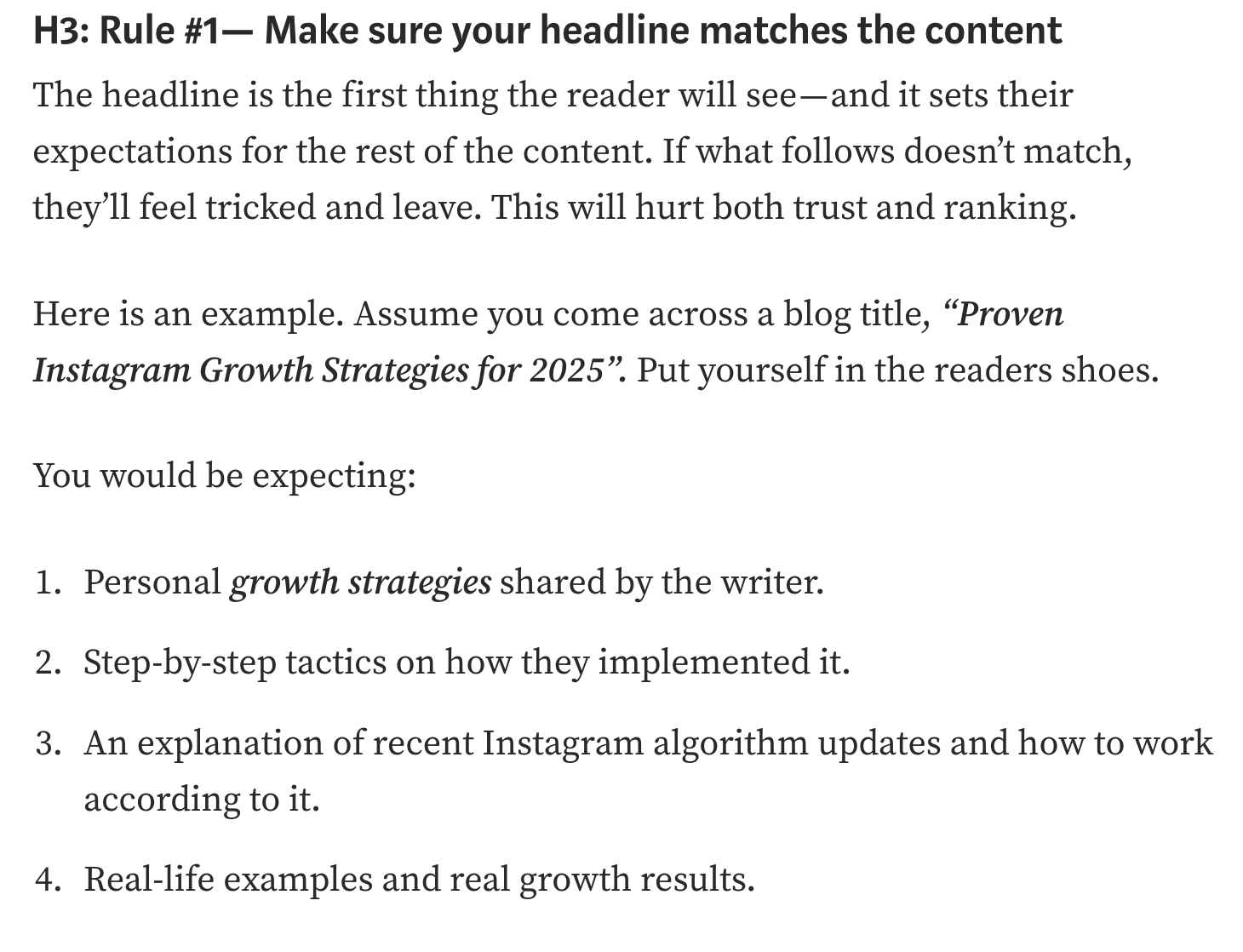
Fluff often signals low effort to search engines because it adds length without adding value. Therefore, five paragraphs were replaced by one, followed by the example. Short, no fluff, and to the point. This is exactly what the reader wants.
Rule #3: Check the Grammar and Readability Score of Your Blog Post
Write how your audience reads. No one cares how academically inclined you are, so avoid technical jargon. The content should be so easy to understand that even a 5th grader could follow along.
How to Check Grammar and Readability Score?
To improve your grammar and readability score, you need two free tools:
- Hemingway Editor
- Grammarly
Hemingway Editor
The Hemingway Editor is a freemium tool that offers the sentence complexity checker functionality. It highlights complex sentences with yellow (hard-to-read) or red (very hard-to-read). Using this feature, you can simplify the sentence to improve the overall readability score.
Grammarly
Grammarly is a famous freemium content editor web application. You can get instant access to fixes for grammatical errors.
Rule #4: Self-evaluation to Check For Low-Quality Content
Self-evaluation to check for low-quality content is crucial. Here are four ways to know if your content is good or not.
1.) Not Engaging
If readers aren’t nodding along as they read your post, it means you have failed to create a connection. To know if your content is engaging, read it and see if you like what you have written.
2.) Failed to Provide Actionable Steps
If your content lacks actionable steps, it’s a sign of low-quality content. You should write everything step-by-step, as if you are spoon-feeding the reader.
3.) Keyword Stuffing
If your content contains keywords stuffed in sentences, it means you are writing for search engines, not for people. Google doesn’t promote such content because it isn’t considered helpful to the reader.
Ask yourself:
- Does the content provide actionable steps?
- Does the content answer the question it targets?
- Would a beginner know what to do next after reading?
- Did I explain how and why, not just what?
If your content forces the reader to search again, it’s likely unhelpful.
Rule #5: Avoid Rewriting Competitor Content – It is Unoriginal
Google strongly devalues unoriginal content. Copying and pasting content from various sources and rewriting it in your own words is still counted as unoriginal content.
How to Check If My Post is Similar to My Competitors’ Post?
Here’s a step-by-step method you can use for any blog post to evaluate whether your post matches or overlaps with a competitor’s post.
1.) Search Your Main Keyword on Google
Type your primary keyword into Google and open the top 5–10 ranking pages. These are the pages Google already considers “good enough.” Therefore, compare your post with theirs.
2.) Analyze the Structure
If your post follows the same structure as top-ranking pages, it’s a red flag. Google evaluates content patterns, not just rewritten sentences. Even if the wording is different, an identical structure signals that the content was rewritten.
3.) Check How Your Content is Different
Perform a side-by-side comparison to understand how your content differs from your competitor’s.
Ask yourself questions:
- Did I provide deeper explanations?
- Did I share personal experience and original insights?
- Did I share any practical steps that my competitor skipped?
If your post doesn’t go beyond these repeated points, it’s unoriginal.
Conclusion
By following the above 5 rules for every post, you can check for low-quality content before publishing. If a post passes these five rules, it is unlikely to be flagged as low-quality even during major Google updates.